A while ago I finished my first big personal data science project with Python, where I applied what I was learning to a real question I had. Well, it may never be completely finished, but at some point I realized you have to decide you’ve done more or less what you set out to do, and move on. It was a rewarding experience and I wanted to offer up some reflections for others who might be thinking about embarking on their own side projects, to help you set yourself up for success.
Ask the Right Questions
Choose a question that you can find data for, and that interests you. Better yet, choose a question that will contribute something to your field. You’ll be spending a lot of time on this, so you might as well be invested in it.
Set Your Expectations
In the end, I spent much less time than I thought actually writing code and much more time troubleshooting, as I have mentioned before. This summarizes my expectations vs reality:
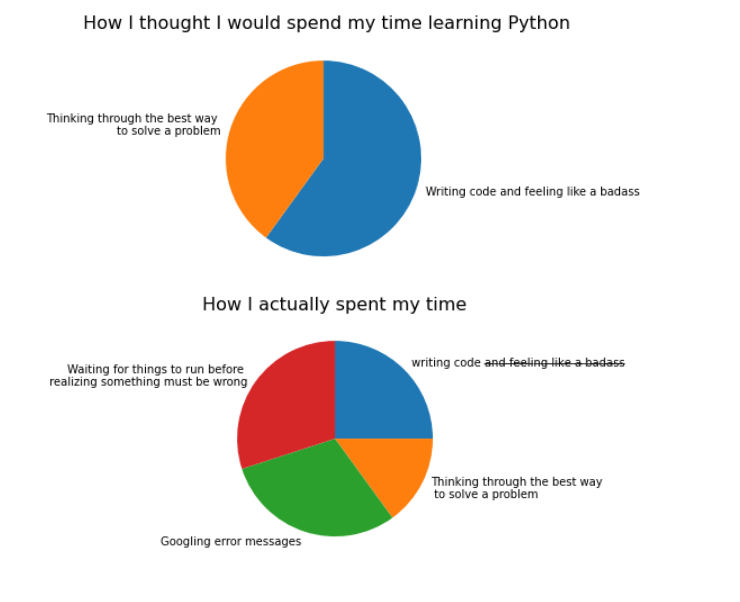
(Of course, I created this in Python and the code is here.)
Choose the Right Tools
You’ll want to decide in what format you are going to keep your code and what tool you will use to code.
My first online Python course taught us to write code in a text editor, which worked well for class. Later, though, I spent a good deal of time being confused about what environments are because they were never explained. In short, to use libraries in Python (pre-made bits of code) you need to install the packages where those libraries live, but sometimes you want a newer version of a package and sometimes you may want an older version, because code changes with time. I did not fully appreciate how complicated it can be to figure this out and when I discovered Anaconda that made things much easier, because Anaconda is a package manager that helps you manage your environments for different projects.
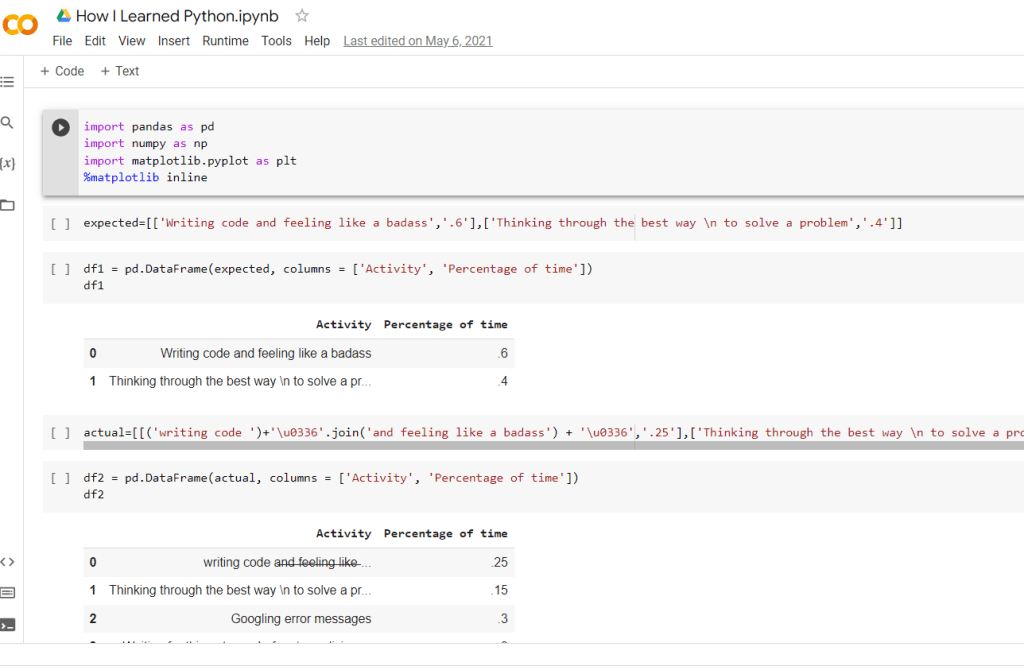
I started out using a Jupyter notebook through Anaconda, but I still found myself getting frustrated by what sometimes seemed like an endless cycle of packages being dependent on other packages that I didn’t yet have. I switched to Google Colaboratory notebook, which has made my life much easier. It turns out, with the Colab you don’t have to worry about managing your environments, as it does this for you. It’s in the cloud, so you need a constant internet connection, and the process of importing or exporting files is different. But my code has examples of how to do this, and it’s well worth the short learning curve.
Build Your Support Network
You are going to spend a lot of time looking for help or diving deeper into a topic, and in time you’ll figure out what resources you like best. Stay open to different sites, blogs, or even books until you figure out what speaks to you. I tend to like what I read on Geeks for Geeks, so when I google a topic I don’t understand well and a Geeks for Geeks answer comes up, that’s usually the first one I click on, even if it’s halfway down the page. I’ve just learned that the way they explain things makes sense to me. I’ve also found good content on Programiz. Find something that resonates with you, because the learning never ends.

Revise and Repeat
Don’t delay too much in starting your first project. Rather than preparing until you think it’ll be perfect, get out there and start something. You will always have more to learn, so don’t let that stop you. But stay open to revisions and feedback from people who know more than you do. You can learn as much from others’ feedback as from any class, so be grateful for it.
I hope this is helpful as you start to think about trying out your own skills for the first time!
 Nerd on the Bus
One thought on “Prepare Well for your First Side Project”